
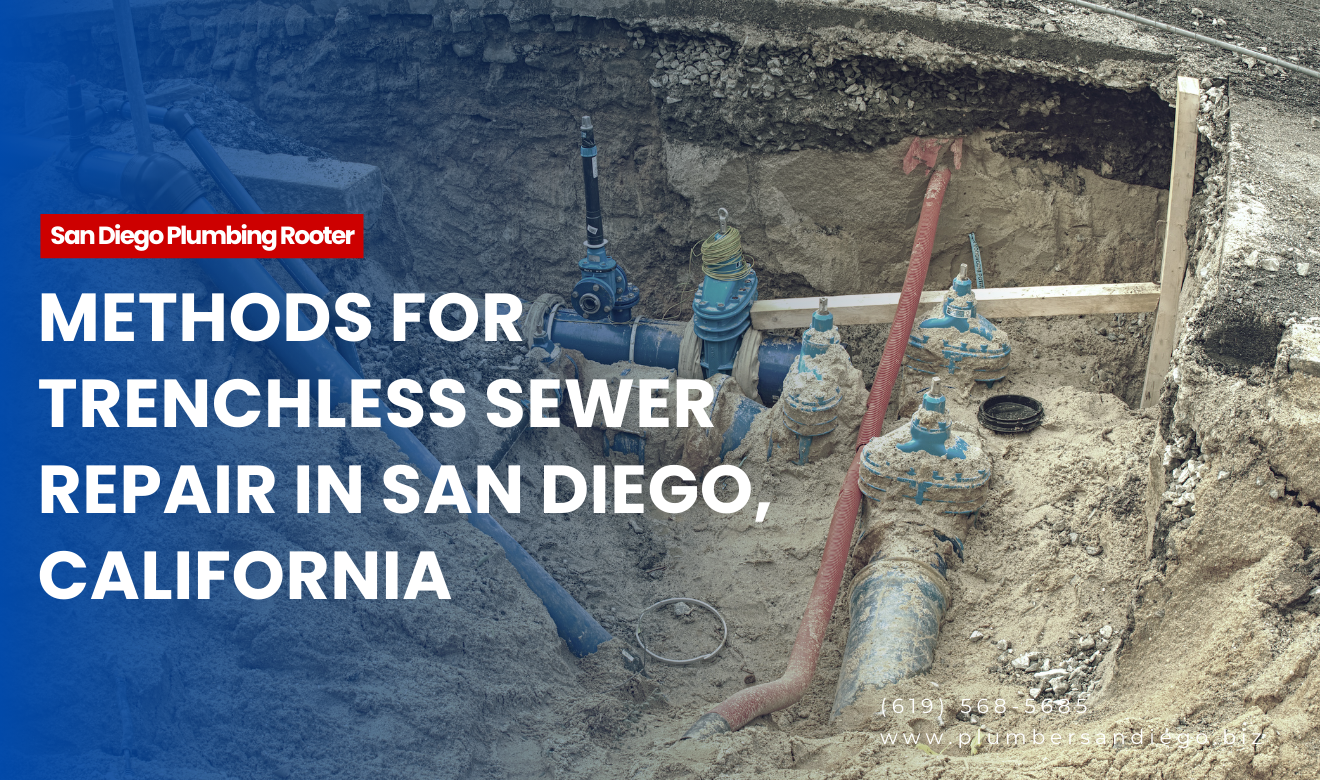
If you want to compare trenchless sewer repair options San Diego homeowners use most, focus on three methods: pipe lining (CIPP), pipe bursting, and spot repairs. These approaches fix damaged sewer lines with little to no digging, which can protect your driveway, patio, or landscaping. For example, if your clay pipe has cracks and root intrusion but the line is mostly intact, lining can seal it from the inside. If the pipe has collapsed or is severely offset, pipe bursting can replace it by breaking the old pipe while pulling a new one through. And if only one section is damaged—like a short area under a walkway—a targeted spot repair may be the simplest solution.
What “Trenchless” Really Means (and What It Doesn’t)
Before you compare trenchless sewer repair options San Diego homeowners rely on, it helps to understand the promise of “trenchless.” In most cases, trenchless methods:
- Use existing access points (like cleanouts) and small entry/exit pits instead of open trenching.
- Repair or replace pipes underground with minimal surface disruption.
- Rely on camera diagnostics to verify damage and confirm results.
What trenchless doesn’t mean: “no excavation ever.” Even when you compare trenchless sewer repair options San Diego contractors offer, some digging may still be needed for access, for a collapsed section, or to meet code at a connection point.
Quick Side-by-Side Comparison: Lining vs. Bursting vs. Spot Repair
If your main goal is to compare trenchless sewer repair options San Diego residents see in estimates, the chart below summarizes where each method shines.
| Method | Best For | Not Ideal When |
|---|---|---|
| CIPP pipe lining | Cracks, small offsets, root intrusion in mostly intact pipe | Pipe is crushed/collapsed, severely misaligned, or has major missing sections |
| Pipe bursting | Collapsed lines, repeated failures, full replacement without open trenching | Limited space for pits, complex crossings, or situations requiring delicate utility avoidance |
| Spot repair (targeted excavation) | One localized break, short bad segment, accessible area | Multiple failing sections, aging pipe throughout, chronic root intrusion |
| Hybrid approach | A short dig to fix a belly/collapse + lining the remainder | Damage is extensive end-to-end or diameter changes are needed |
Option 1: CIPP Pipe Lining (Cured-In-Place Pipe)
When you compare trenchless sewer repair options San Diego homeowners choose for older clay or cast iron, CIPP lining is often the “repair from within” solution. A resin-saturated liner is inserted into the existing pipe, inflated, and cured to form a new, jointless pipe inside the old one.
Best Use Cases for Pipe Lining
- Hairline cracks and small fractures
- Root intrusion entering through joints
- Corrosion or scaling in older lines (common in aging metal pipes)
- Leaks causing soil washout—when the pipe still holds shape overall
Key Pros (Why It’s Popular)
- Minimal disruption: Often only needs access through cleanouts.
- Jointless interior: Helps reduce future root intrusion points.
- Improved flow: A smoother interior can reduce friction losses.
- Fast turnaround: Many residential jobs can be completed in a day, depending on prep and curing method.
Key Cons (What to Watch For)
- Not for collapsed pipes: Lining can’t “re-round” a pipe that’s crushed.
- Diameter reduction: The liner slightly reduces internal diameter (usually not an issue, but important for marginal slope/flow situations).
- Prep matters: Heavy scale or roots must be thoroughly cleared first or the liner may not bond properly.
What Usually Comes Before Lining
To accurately compare trenchless sewer repair options San Diego contractors recommend, ask what diagnostics and prep are included. Lining typically requires:
- Camera evaluation to map cracks, offsets, and branch connections
- Descaling and root removal (often via jetting or mechanical cutting)
- A post-lining camera verification
If you’re already dealing with chronic backups, scheduling a Sewer Video Inspection is often the fastest way to confirm whether lining is realistic—or if you’re looking at replacement.
Option 2: Pipe Bursting (Trenchless Replacement)
If you compare trenchless sewer repair options San Diego homeowners use for severely damaged lines, pipe bursting stands out because it’s a full replacement method. A bursting head breaks apart the old pipe while pulling a new pipe (commonly HDPE) into place.
Best Use Cases for Pipe Bursting
- Collapsed sewer lines or major deformation
- Repeated failures in clay pipe with shifting soil
- Old lines with widespread cracking and offset joints
- Situations where a long stretch needs replacement without tearing up hardscape
Key Pros
- True replacement: You end up with a brand-new pipe, not a patch.
- Long-term reliability: Fewer joints (especially with fused HDPE runs).
- Good for “beyond repair” lines: Works where lining can’t.
Key Cons
- Requires entry/exit pits: Still far less disruptive than full trenching, but not “dig-free.”
- Utility awareness is critical: Bursting displaces material outward, so careful planning matters near other buried lines.
- Not always the cheapest: Replacement can cost more upfront than lining—though it may reduce repeat repairs.
Real-World Example (Common San Diego Scenario)
A frequent reason to compare trenchless sewer repair options San Diego property owners request is a recurring backup in a 1950s–1970s home. A camera inspection may reveal clay pipe sections that have shifted and created a “stair-step” offset. If multiple offsets exist or a section has collapsed, pipe bursting can be the practical choice because it eliminates the weak line entirely rather than sealing around it.
Option 3: Spot Repairs (Targeted Excavation)
Spot repair isn’t always marketed as “trenchless,” but it’s often the least invasive practical fix when damage is limited. When you compare trenchless sewer repair options San Diego homeowners consider, spot repair is the “fix only what’s broken” approach—especially when the damaged area is short and accessible.
Best Use Cases for Spot Repairs
- A single cracked section caused by roots or soil settlement
- Damage near a cleanout or property line
- A localized issue under a small patch of landscaping (not a full driveway)
Pros
- Lower cost for isolated issues: You’re not paying to rehabilitate an entire line unnecessarily.
- Simple and direct: Remove the bad section, install new pipe, restore service.
- Ideal when lining/bursting isn’t possible: Example: a short collapse that must be physically removed.
Cons
- Not future-proof if the rest of the pipe is aging: Another section may fail later.
- Surface restoration: You may need concrete/asphalt repair depending on location.
How to Choose the Right Method (Decision Factors That Matter Most)
The most accurate way to compare trenchless sewer repair options San Diego homes need is to base the decision on pipe condition, layout, and long-term risk—not just the initial estimate.
1) Pipe Material and Age
- Clay: Commonly affected by root intrusion at joints. Lining often works if not collapsed; bursting is better for widespread offsets/collapse.
- Cast iron: Often corrodes and scales internally. Lining can help if structure is intact. If the pipe is heavily deteriorated, replacement may be smarter. (Related reading: cast iron replacement.)
- ABS/PVC: Newer, but can still fail from poor slope, soil movement, or construction damage.
2) Severity and Location of Damage
- Minor cracks + roots: Lining is often a strong candidate.
- Single break: Spot repair can be most efficient.
- Collapse / severe offset: Pipe bursting is usually the better long-term fix.
3) Yard, Driveway, and Hardscape Impacts
People often compare trenchless sewer repair options San Diego contractors offer because they want to avoid tearing up expensive exterior improvements. Lining typically has the least surface impact, pipe bursting has moderate impact (pits), and spot repairs vary based on where the damaged section sits.
4) Long-Term Costs vs. Upfront Price
A cheaper repair isn’t always cheaper over time. If your line has multiple weak points, paying for repeated spot repairs can add up quickly compared with lining or bursting.
Typical Process Timeline (What Homeowners Can Expect)
When you compare trenchless sewer repair options San Diego residents schedule, most projects follow a similar workflow:
- Diagnostic camera inspection: Locate damage, measure distances, assess pipe condition.
- Cleaning/prep: Remove roots, grease, and scale so repairs bond or replacement proceeds safely.
- Repair day: Lining install and curing, bursting pull-through, or targeted excavation and replacement.
- Verification: Final camera pass to confirm flow and integrity.
Cost Drivers (Why Estimates Vary So Much)
If you compare trenchless sewer repair options San Diego pricing for different homes, you’ll notice big swings. Common drivers include:
- Pipe length and diameter: Longer runs and larger diameters increase materials and labor.
- Number of bends and branch lines: Complex layouts can raise difficulty for lining and replacement.
- Condition of the pipe: Heavy scale/root removal increases prep time.
- Access: Limited cleanout access or deep lines may require additional work.
- Restoration needs: Concrete cutting and patching can add significant cost for spot repairs or access pits.
Permits, Code, and Documentation (Often Overlooked)
When you compare trenchless sewer repair options San Diego homeowners move forward with, don’t skip the “paperwork” questions. Sewer work can trigger permit requirements depending on scope and location. A quality provider typically offers:
- Camera recordings or images (before and after)
- Written scope of work (what method, what footage, what exclusions)
- Warranty details (what’s covered and for how long)
Understanding the basics of plumbing systems also helps you evaluate proposals—especially around drainage slope, venting, and connections.
Featured Snippet: Which Trenchless Method Should I Choose?
Choose CIPP lining if your pipe is mostly intact but has cracks, leaks, or root intrusion. Choose pipe bursting if the line is collapsed, severely offset, or failing in multiple areas and needs full replacement. Choose a spot repair if damage is limited to one short, accessible section and the rest of the line is in good shape.
Common Mistakes When People Compare Options
Homeowners trying to compare trenchless sewer repair options San Diego plumbers propose can avoid a lot of frustration by watching for these pitfalls:
- Skipping the camera inspection: Guessing leads to the wrong method.
- Comparing price without comparing scope: One bid may include cleaning, reinstating branches, and final verification; another may not.
- Not addressing the cause: Roots, grease, and structural movement can cause repeat issues if not handled.
- Ignoring maintenance: Even a repaired sewer line can back up if grease and debris build up.
For ongoing prevention, consistent upkeep matters—especially in older neighborhoods. Practical habits like periodic cleaning and avoiding grease disposal align closely with smart drain maintenance.
Trust Signals to Look For in a Trenchless Contractor
To confidently compare trenchless sewer repair options San Diego homeowners are offered, evaluate the contractor as much as the method:
- Specialized equipment: Camera locating, cleaning tools, lining or bursting systems appropriate for residential mains.
- Transparent verification: Before/after video, measured distances, clear defect identification.
- Code-aware approach: Willingness to pull permits when required and document materials used.
- Safety practices: Utility marking coordination and safe access pit practices where applicable.
- Clear warranty language: Written coverage terms for labor and materials.
From Mess to Modern: The Smart Way to Protect Your Property
When you compare trenchless sewer repair options San Diego homeowners use most—CIPP lining, pipe bursting, and spot repair—the “best” choice depends on what the camera shows and how long you plan to stay in the home. Lining is often ideal for sealing cracks and stopping root intrusion in an otherwise stable line. Pipe bursting is the go-to when the pipe is beyond saving and you need a true replacement without full trenching. Spot repairs make sense when the problem is isolated and access is straightforward.
For the most reliable outcome, the decision should be based on documented pipe condition (video evidence), proper cleaning and preparation, and a final verification inspection—not guesswork. Contractors who routinely perform sewer diagnostics and trenchless work typically follow industry-standard practices: camera locating, pipe cleaning, code-compliant materials, and post-repair proof—building the kind of accountability homeowners need when they compare trenchless sewer repair options San Diego properties require.
Keyword check: compare trenchless sewer repair options San Diego.
Frequently Asked Questions
Ready to Choose the Right Trenchless Fix (Without Guesswork)?
If you’re comparing lining vs. bursting vs. spot repair, the smartest next move is a camera-based game plan—so you’re not paying for the wrong solution (or the same repair twice). San Diego Plumbing Rooter can inspect your line, show you exactly what’s happening on video, and recommend the most cost-effective trenchless option for your home—with a clear scope, realistic timeline, and straightforward pricing.


