
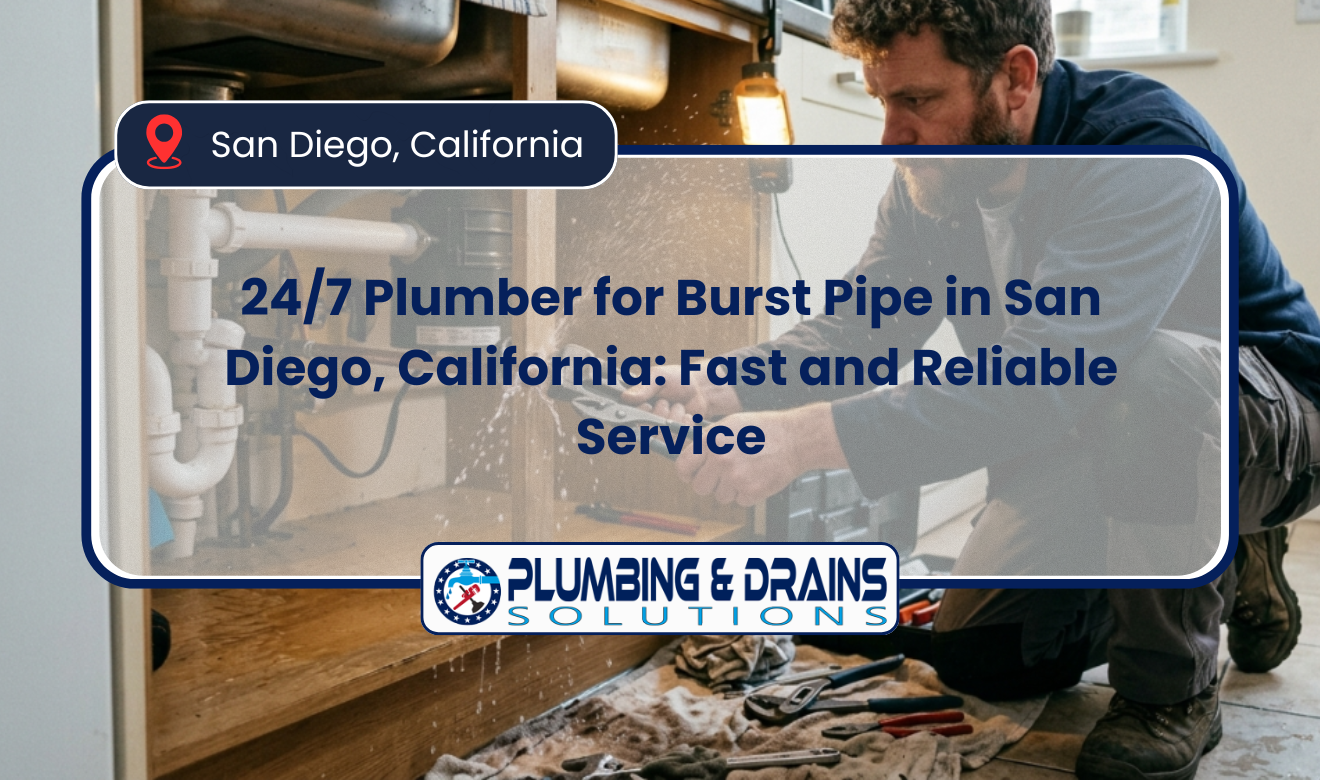
Executive Summary: A burst pipe emergency in San Diego is resolved by immediately isolating the water supply, accurately confirming the leak location, and completing a pressure-rated repair while starting moisture containment to prevent secondary damage. The definitive outcome depends on restoring stable 60–80 PSI operation, verifying zero unintended meter flow, and checking for root-cause issues like PRV failure or systemic pipe corrosion.
- Immediate Isolation First: The fastest way to limit structural damage is shutting the main water valve, relieving line pressure, and confirming the meter stops moving before any repair work begins.
- Precise Leak Location Prevents Over-Demo: Combining pressure isolation behavior, acoustic detection, thermal imaging, and meter verification identifies the true failure point so walls or slab aren’t opened unnecessarily.
- Pressure-Stable Repair Stops Repeat Failures: Replacing or bypassing the failed section must be followed by controlled repressurization, inspection for secondary leaks, and verification of PRV/expansion conditions to prevent another rupture.
A 24/7 plumber for burst pipe San Diego provides immediate emergency pipe isolation, repair, and water-damage prevention at any hour in San Diego, California. Burst pipes often happen after sudden pressure spikes, failed pressure regulators, corroded galvanized lines, or split copper near exterior walls in neighborhoods with older plumbing, like North Park and City Heights. A true emergency response starts with shutting the main water valve, confirming the leak point with acoustic detection or thermal imaging, and staging water extraction to limit drywall saturation and floor cupping. Common urgent fixes include replacing a cracked copper section with new Type L copper, installing a PEX sleeve for a pinhole rupture, or cutting out a failed solder joint and pressure-testing the line back to 60–80 PSI. In coastal areas like Pacific Beach and Point Loma, salt air and age can accelerate corrosion, so technicians often inspect for green patina on copper, active weeping at fittings, and low-pressure symptoms tied to hidden slab leaks. Fast service also includes documenting moisture readings, checking for secondary leaks at angle stops and water heaters, and restoring flow safely with a temporary bypass when a full repipe cannot be completed the same night.
What “Burst Pipe Emergency” Means in San Diego Homes
A burst pipe emergency is any sudden loss of pipe integrity that requires immediate isolation to prevent structural water damage and unsafe conditions. In San Diego, this often involves older copper, galvanized steel, or slab-routed lines where leaks can spread unnoticed into walls, ceilings, or foundations.
Common local scenarios include:
- Split copper on exterior walls (temperature swings, vibration, or poor strapping), especially in older housing stock.
- Galvanized steel failure from internal rust and restriction that elevates pressure and accelerates rupture risk.
- Pressure regulator (PRV) malfunction allowing high street pressure to reach fixtures and solder joints.
- Slab-related leaks where a pinhole or crack can saturate soil and migrate under flooring before it becomes visible.
Because water can travel along framing and subfloor pathways, the urgency is less about the “size” of the break and more about how quickly the water is stopped, the wet area is mapped, and moisture is extracted.
Immediate Actions a 24/7 Emergency Plumber Follows (First 30–90 Minutes)
The first phase is a controlled shutdown, verification of the active leak, and prevention of secondary damage. A proper emergency workflow reduces the chance of mold growth, electrical hazards, and avoidable demolition.
On arrival, a qualified technician typically follows a documented sequence:
- Confirm safety and isolate water
- Locate and close the main water shutoff (often at the meter) and confirm the meter stops spinning.
- Open the highest and lowest fixtures to relieve pressure and drain residual water.
- If the leak is hot-water-side, isolate at the water heater cold supply when appropriate.
- Identify the leak source
- Use acoustic listening to locate pressurized leaks inside walls or below slab.
- Use thermal imaging to trace temperature anomalies consistent with hot water migration.
- Perform visual confirmation at fittings, angle stops, exposed risers, and accessible crawl spaces.
- Control water spread
- Stage extraction (wet vac, pump-out, or extraction mats where applicable).
- Protect adjacent materials with plastic sheeting and relocate vulnerable items.
- Document initial conditions with photos and moisture readings to guide drying decisions.
- Stabilize the plumbing system
- Cap or bypass the failed section so the property can regain partial water service if feasible.
- Plan a code-compliant permanent repair if parts, access, or drying constraints prevent same-night completion.
If you need guidance on locating and operating shutoffs fast, see water and gas emergency shut-off valves.
How Leak Location Is Confirmed Without Unnecessary Demolition
Accurate location comes from combining instrument readings with plumbing layout logic, not guesswork. This reduces drywall removal, avoids cutting the wrong slab area, and accelerates permanent restoration.
Methods used in San Diego emergency calls typically include:
- Pressure isolation testing: segmenting supply branches (when valving exists) and observing pressure drop behavior.
- Acoustic leak detection: listening for leak turbulence transmitted through pipe and structure.
- Thermal mapping: identifying hot-water migration patterns in walls/ceilings or slab.
- Meter confirmation: verifying continuous flow at the water meter with all fixtures off to confirm an active supply-side leak.
In older neighborhoods with mixed materials, technicians also verify pipe type and expected routing (copper vs. galvanized vs. PEX) before opening walls, since repair approach and fittings differ.
Emergency Repair Options Used for Burst Pipes (What Gets Done On-Site)
Emergency repairs prioritize a secure, pressure-rated restoration of service and then a durable, code-aligned permanent fix. The exact method depends on pipe material, accessibility, and extent of corrosion.
Common urgent repair pathways include:
- Copper replacement (Type L copper)
- Cut out the split or pinholed segment back to sound pipe.
- Install a new section using properly cleaned and prepped joints, then test under operating pressure.
- Where soldering is unsafe (wet pipe, confined spaces), a code-approved press fitting system may be used if locally accepted and installed per manufacturer instructions.
- PEX repair or transition
- Use the correct ASTM-rated fittings and clamps/crimps for the PEX system present.
- When transitioning copper-to-PEX, install approved transition fittings and support/strapping to avoid stress at joints.
- Galvanized failure mitigation
- Localized patching is often temporary due to internal corrosion and thinning.
- Technicians may recommend targeted replacement or repiping sections to stop repeated ruptures and pressure loss.
- Temporary bypass (when full repair must wait)
- Bypass a failed branch to restore water to essential areas while isolating the damaged run.
- Label and document which fixtures are isolated to prevent accidental activation.
Pressure, Regulators, and Why 60–80 PSI Matters in Practice
Controlling pressure protects solder joints, angle stops, and appliance connectors from repeat failures. In residential plumbing, maintaining stable operating pressure helps prevent new leaks after a burst-pipe event.
After an emergency fix, technicians commonly verify:
- Static pressure (no water running) and dynamic pressure (fixtures running) to spot regulator issues.
- Thermal expansion symptoms such as periodic pressure spikes when the water heater cycles; expansion control may be needed depending on system configuration.
- PRV performance and whether it is stuck, drifting, or incorrectly set.
When pressure control is part of the root cause, addressing it is not optional—it is the preventative step that stops a “repair tonight / new leak next month” cycle. For corrective work on pressure control, see Water Pressure Regulators.
San Diego Material and Environment Factors That Accelerate Failures
Local corrosion and building age influence how pipes fail and how repairs should be scoped. Coastal salt air, older copper, and legacy galvanized lines can all change what “best fix” means.
Technicians routinely check for these field indicators:
- Green patina and weeping joints on copper near fittings, valves, or strapped contact points.
- Pinhole patterns that suggest systemic copper deterioration rather than a single isolated defect.
- Galvanized restriction (low flow, discolored water, recurring leaks) which often indicates internal rust scaling.
- Hidden slab moisture seen as warm spots (hot line), flooring tenting, or persistent musty odor despite surface drying.
For broader context on how residential systems are built and connected, refer to plumbing.
Water-Damage Containment Steps That Should Start During the Plumbing Repair
Stopping the leak is only half the emergency; controlling moisture migration is what prevents secondary damage. Coordinated extraction and drying decisions reduce the chance of warped flooring, cabinet swelling, and microbial growth.
Standard containment actions include:
- Moisture mapping with readings taken at baseboards, drywall, and floor transitions to define the wet footprint.
- Targeted water extraction before air movement, since evaporation alone is too slow when materials are saturated.
- Controlled airflow strategy to avoid pushing moisture deeper into cavities (especially where insulation is present).
- Secondary leak check at angle stops, toilet supplies, water heater connections, and exposed manifold areas after repressurization.
When a burst line has impacted drywall, flooring, or cabinetry, coordinating with a Water Damage Restoration Service helps align plumbing clearance, drying plans, and material removal decisions.
Core Metrics Used to Decide “Repair vs. Repipe” (Data Table)
Decision-making should be based on measurable system condition, not only the visible break. The table below consolidates common diagnostics that determine whether a localized repair is reliable or whether broader replacement is the safer long-term remedy.
| Feature / Metric | Specifications | Local Guidelines |
|---|---|---|
| Post-repair pressure verification | Confirm stable operating pressure after repair and while fixtures run; verify no continuing flow at the meter with fixtures off | If pressure is unstable or spikes after a water-heater cycle, evaluate PRV function and expansion control before restoring full service |
| Pipe condition at cut point | Copper: look for thinning, pitting, or dezincification at fittings; Galvanized: internal scaling and reduced ID | If adjacent pipe shows systemic deterioration (multiple pinholes, heavy corrosion, repeating leaks), scope replacement beyond the single failed section |
| Leak accessibility and building impact | Wall/ceiling access vs. slab routing; presence of insulation, cabinetry, tile, or post-tension slab constraints | When access would require extensive demolition, consider rerouting lines through walls/attic where feasible to reduce future repair disruption |
| Moisture spread boundary | Moisture readings at baseboards, drywall, flooring edges; visible cupping, swelling, or staining | Use mapped readings to define drying vs. removal decisions; verify no secondary leaks before drying begins |
When the Problem Isn’t the Supply Line: Drain Backups That Look Like “Burst Pipes”
Not every water-on-the-floor event is a pressurized pipe failure; some are sewer or drain overflows that require different containment and tools. Identifying whether water is clean supply water or wastewater changes both safety steps and repair scope.
Indicators it may be a drain/sewer problem instead of a supply burst:
- Water appears when a fixture drains (shower, washing machine) rather than continuously.
- Multiple fixtures back up at once (toilet gurgling when tub drains).
- Water has odor, discoloration, or visible debris.
If the event points to a backup rather than a pressurized leak, see drain repair for the appropriate next steps and typical corrective options.
Restoring Water Safely After the Repair (Avoiding a Second Failure)
Repressurizing too fast can trigger another weak point, especially in older copper and galvanized systems. A controlled restart ensures the repaired section holds and exposes hidden seepage before it becomes a new flood.
A careful restore procedure includes:
- Close fixtures opened for draining, leaving one cold fixture cracked open to bleed air.
- Slowly open the main shutoff to refill the system gradually.
- Inspect every accessible joint near the repair, water heater connections, and angle stops for active seepage.
- Run hot water after cold is stable to purge air from the heater loop and confirm no hot-side leaks.
- Re-check the meter with all fixtures off to confirm no hidden continuous flow.
Key Takeaways for Fast, Damage-Limiting Burst Pipe Response in San Diego
Effective emergency plumbing is defined by immediate isolation, precise leak location, pressure-safe repair, and coordinated moisture control. The best outcomes come from treating the burst as both a plumbing failure and a water-intrusion event that must be stabilized methodically.
- Shut off water first, then confirm leak location using acoustic/thermal tools where needed.
- Use repair methods matched to material (Type L copper sections, proper PEX fittings, and realistic planning for galvanized deterioration).
- Verify stable pressure and regulator performance to prevent repeat ruptures after service is restored.
- Map moisture and start extraction early to reduce drywall saturation, flooring deformation, and secondary damage.
- Confirm no secondary leaks at valves, heater connections, and fixtures during controlled repressurization.
Frequently Asked Questions
Don’t Let a Burst Pipe Turn Into a Full-Scale Remodel
A burst pipe isn’t just “a leak.” In minutes, it can soak insulation, wick into drywall, cup flooring, and quietly feed mold in places you can’t see. And if you guess wrong on the shutoff, repressurize too fast, or slap on a temporary fix without confirming pressure and pipe condition, you can trigger a second failure that’s even worse than the first.
Here’s what typically goes sideways when homeowners try to handle it alone:
- Water doesn’t actually stop because the wrong valve was closed, the main won’t fully seat, or a hot-side line is still feeding the break.
- Hidden damage spreads behind walls and under floors while you focus on the visible water—leading to bigger demolition later.
- “Quick fixes” fail under pressure because the root cause (high PSI, a failing PRV, corrosion, or a weak joint) wasn’t diagnosed and corrected.
- Misdiagnosis costs time when it’s not a supply burst at all—but a drain/sewer overflow that requires a completely different response.
- Repressurizing triggers new leaks in older copper or galvanized lines when the system is refilled too quickly.
If you’re in San Diego, the smartest move is to treat this like the emergency it is: isolate the water fast, confirm the leak location with the right tools, perform a pressure-rated repair that matches the pipe material, and start moisture containment before the damage footprint grows.


